Understanding Momentum in Binary Options Trading
Momentum, a fundamental aspect of financial markets, plays a significant role in binary options trading. It refers to the force or speed involved in market movements and effectively measures how quickly a security’s price moves either upward or downward. Traders who engage in binary options trading often use momentum as a strategic tool to predict potential price changes, thereby making informed decisions on their trades. This exploration provides an in-depth understanding of how momentum functions within this trading environment and its overall implications.
The Basics of Momentum
The concept of momentum is rooted in the principle that a price trend demonstrating consistent directional movement is likely to persist. Traders utilize momentum indicators such as the Relative Strength Index (RSI) and Moving Average Convergence Divergence (MACD) to evaluate the strength of ongoing trends. These tools offer valuable insights, allowing traders to determine whether a trend is robust or weakening, thereby facilitating smarter trading choices.
Momentum Indicators
Understanding how to effectively use momentum indicators can provide a trading edge. Here is an exploration of some of the most prevalent indicators used in binary options trading:
1. Relative Strength Index (RSI): The RSI operates as a momentum oscillator and functions within a scale of 0 to 100, designed to spot overbought or oversold market conditions. When the RSI surpasses 70, it typically signifies an overbought market, suggesting a potential pullback or reversal. Conversely, an RSI reading falling below 30 is generally indicative of an oversold market, often a precursor to upward movements.
2. Moving Average Convergence Divergence (MACD): MACD is another critical momentum indicator that explores the connection between two moving averages of a security’s price. Traders frequently seek out particular signals like crossovers and divergences within the MACD line and signal line, as such signals might imply potential future price movements. The momentum indicated thus provides an invaluable perspective on likely market directions.
Momentum Strategies in Binary Options Trading
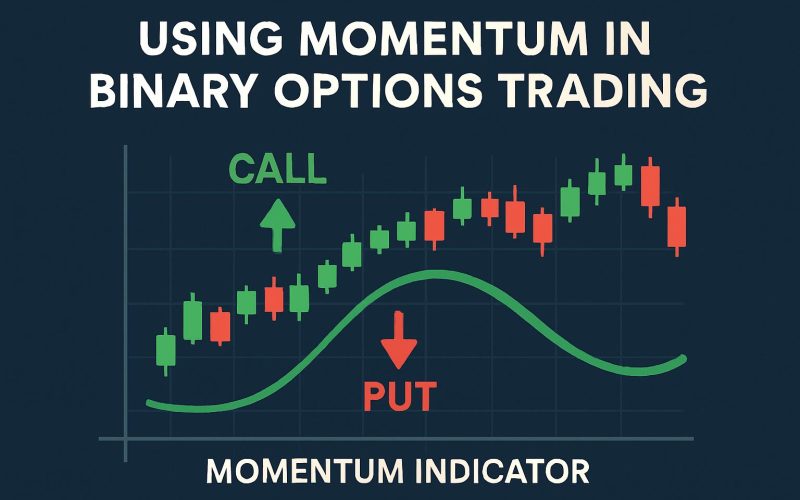
In binary options trading, momentum can be strategically utilized to capitalize on short-lived price shifts. One notable approach embraced by traders is trend-following, which involves placing a ‘call’ option if bullish momentum is strong or a ‘put’ option if bearish momentum dominates. This strategy relies on analyzing the market’s energy and making decisions aligned with its direction.
An alternate strategy is counter-trend trading. This involves taking positions contrary to the current momentum when indicators suggest an impending reversal. For instance, when the RSI points to an overbought scenario, a trader might decide to wager on a ‘put’ option, anticipating that the price might soon decline. Using momentum in this manner allows traders to leverage potential turning points in markets for profit.
Risks and Considerations
While integrating momentum into binary options trading strategies offers advantages, such applications also present notable risks. Market patterns can vary and be unpredictable, and even trusted indicators may emit misleading signals. Traders must exercise caution and consider employing risk management methods like establishing stop-loss criteria and diversifying their investment portfolio to mitigate potential losses.
Further complicating this is the fast-paced environment inherent in binary options trading, where trades often come with short expiration times. Here, precision in decision-making is key, necessitating a sound understanding of momentum dynamics. Traders must not only familiarize themselves with momentum concepts but also continuously refine their skills and adapt strategies to align with market evolutions.
For those keen on delving deeper into momentum trading and acquiring advanced strategies, recourses such as online courses or webinars from reputable trading institutions can be invaluable. Engaging in these educational opportunities can provide a more thorough grasp of market ebbs and flows, subsequently enhancing trading proficiency.
Conclusion
Ultimately, momentum remains a potent concept within binary options trading, offering traders who can wield it adeptly numerous opportunities. Nevertheless, success in this field is not simply about having the right momentum insights; it also demands rigorous application of risk management principles and strong discipline. Traders need to strike a balance, employing momentum insights collaboratively with effective, disciplined trading practices to maximize the potential for successful outcomes.
This article was last updated on: July 17, 2026