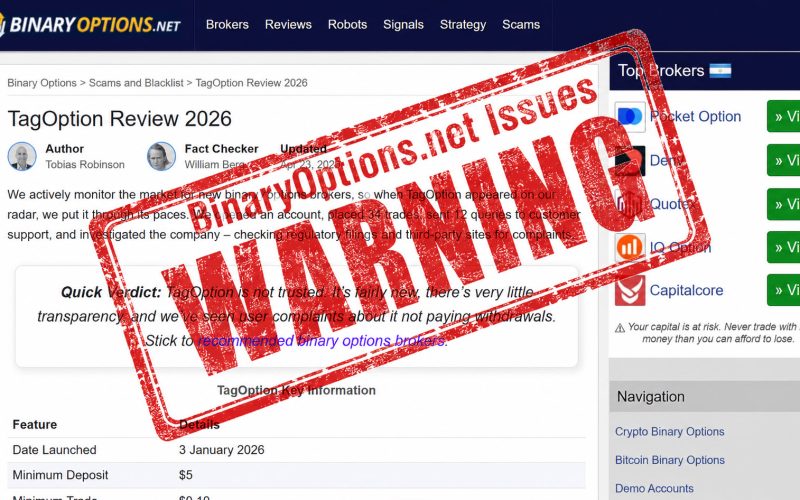
A recent warning from BinaryOptions.net on TagOption offers a useful case study in what a shaky trading operation can look like from the outside and from inside a live test account. According to the review, BinaryOptions.net opened an account, placed 34 trades, sent 12 queries to support, and checked regulatory filings and third party complaints before reaching its verdict. That verdict was blunt: “TagOption is not trusted.” The review tied that conclusion to low transparency, complaints about unpaid withdrawals, and an absence of verifiable corporate and regulatory details.
The details matter because the warning is not built on one vague complaint or a lazy impression. BinaryOptions.net says it found no disclosed legal entity, no licence number, no registered office, and no telephone support number. It also says support staff failed to provide clear answers when asked about ownership and regulation. That is not a small administrative gap for a firm taking client money. It goes to the centre of who the customer is dealing with, where any dispute would be aimed, and whether any regulator can be expected to act over the business at all.
The review also challenged TagOption’s marketing claims. BinaryOptions.net says the site claimed to have more than one million traders, yet the domain was only registered in January 2026 and the platform had almost no third party review footprint, aside from two Trustpilot complaints described as scam related. It also says that despite advertising more than 100 assets, the platform offered only 11 volatility binaries during testing. Those are not necessarily the sort of discrepancies that prove fraud on their own, but they are the sort that should make any trader stop pretending optimism counts as due diligence.
BinaryOptions.net also reported operational issues with the trading interface. In particular, it said some chart settings and indicators did not function despite repeated tests across browsers and on different days. That point matters less than the ownership and regulation problem, but it adds to the broader picture: a platform asking for trust while offering limited transparency and weak evidence that the product is ready for serious use.
The site’s broader index also places this warning in context. BinaryOptions.net says it has reviewed brokers for years, maintains a scams section, and explicitly warns that it will never contact users to open trading accounts or place trades. It also tells readers not to use services on its blacklist. In other words, the TagOption warning is not standing alone. It sits inside a wider pattern of caution around binary brokers, unlicensed operators, and the odd little industry tradition of asking for trust before offering proof. The broader site index is here: BinaryOptions.net.
Why this warning matters beyond one broker
It would be easy to treat the TagOption case as just another negative broker review. That would miss the point. The more useful way to read it is as a practical model for how a higher risk trading operation can look credible enough to attract deposits while still failing the checks that matter. The mechanics are familiar. A clean website appears. The platform promises access to fast trading products. Minimum deposits are low enough to look harmless. Support is available through chat. The brand sounds modern enough. At a glance, none of this screams danger. At a second glance, the structure starts falling apart.
This is exactly why traders with basic knowledge still get caught. They are not always fooled by absurd promises. More often, they are caught by something that looks almost normal. A low minimum deposit can make the risk feel test sized. A modest interface can make the business seem new rather than deceptive. Sparse corporate information can be excused as poor website drafting. Vague support responses can be shrugged off as bad customer service. By the time these separate issues are seen as one pattern, money has often already moved. That is where a review like this helps. It compresses the pattern into one frame and asks the obvious question before the deposit, not after the withdrawal problem.
The case also matters because regulators have spent years warning that unregistered or unauthorised firms, clone brands, and fake soliciting entities continue to target retail investors. The FCA’s Warning List exists precisely because unauthorised firms keep approaching consumers, and its Firm Checker is designed to help users verify whether a company has permission to provide the services it is offering. The SEC’s PAUSE program similarly publishes information on entities that falsely claim to be registered, licensed, or based in the United States, including imposters of real firms and even fake regulators.
There is also a wider market context. Binary options themselves are not automatically fraudulent as instruments, but the sector has a long history of abuse, especially where platforms operate off exchange, hide their legal base, or target retail traders in jurisdictions where access is restricted. BinaryOptions.net itself says that the image of the industry has been damaged by dishonest brokers, signal sellers, and robots, and warns readers to avoid services on its blacklist. That matters because a weak operator does not need to invent an entirely fake market. It only needs to insert itself between the trader and a product category that already carries trust problems.
The safety checks that matter before you deposit
The first check is the least glamorous and the most useful. Identify the legal entity. Not the brand, not the logo, not the support alias, the actual company name. A trading site that cannot tell you who operates it has already failed a basic threshold. In the TagOption review, BinaryOptions.net says it could not find a company name beyond the TagOption brand, nor a physical office address, nor a licence number. That is enough to stop many professionals before they even reach the payment page. Retail traders should hold themselves to the same standard.
Once you have a legal name, check the relevant regulator databases yourself. For UK facing firms, the FCA’s Firm Checker is designed to confirm whether a firm is authorised and has permission to offer the services in question. The FCA also maintains its Warning List for unauthorised firms and individuals it believes are operating without permission. For US investors, FINRA’s fraud guidance is a useful starting point for broker related checks and scam patterns, while the SEC’s investor alerts and PAUSE database warn about unregistered soliciting entities and firms that falsely present themselves as licensed or US based. The CFTC also provides fraud education and public warnings in areas tied to derivatives, leveraged trading, and certain retail speculative products.
The second step is matching, not merely finding. This is where many people get sloppy. It is not enough to locate a real sounding company on a register and assume the website in front of you belongs to it. The website domain, email domain, telephone number, office details, and the legal entity receiving funds all need to match the official record. Clone firms depend on users stopping one step too early. They borrow a name, copy a registration number, or paste a regulator logo on the footer and hope no one notices that the actual contact details do not line up. The SEC’s PAUSE materials and the FCA’s warning resources are both useful reminders that false claims of registration and impersonation are standard tactics, not rare ones.
Payment route checks are another place where fraud often gives itself away. The entity taking the money is the entity that matters. If a broker brand says one thing but the payment beneficiary says another, that deserves a full stop, not a shrug. This applies whether the method is bank transfer, card deposit, e wallet, or crypto. In the TagOption case, BinaryOptions.net noted payment methods including card deposits, M Pesa, and USDT. None of those payment methods is inherently suspicious by itself, but the existence of easy funding options tells you very little about the legal status of the operator behind them. Deposit convenience is not proof. Scammers know that. Actually, they rely on it.
A trader should also test support in a way that produces real answers, not just fast answers. Ask who owns the company. Ask where the business is incorporated. Ask which regulator authorises it. Ask for the exact entity name and the official website on the register. Ask how client money is handled and what complaint route exists. In the TagOption review, BinaryOptions.net says it asked these sorts of questions and received vague responses. That should matter more than whether chat replies arrived within thirty seconds. Quick support is not the same as accountable support.
Operational testing helps too, but it has to be interpreted correctly. A small deposit is useful only if it is part of a wider check. Try the interface. Read the client agreement. Confirm fee language. Test a small withdrawal early. A working deposit flow means almost nothing on its own. A platform’s willingness to return money under stated terms is a more meaningful test, though even that is not conclusive because some scam operations allow early withdrawals to build trust before blocking larger requests. This is why no single check is enough. Safety comes from combined verification, not from one comforting sign.
Domain age and external footprint also help frame the risk. BinaryOptions.net noted that TagOption’s domain was registered in January 2026 while the platform claimed more than one million traders. That mismatch does not need a dramatic interpretation. It just needs a sober one. A large client base usually leaves traces, whether in press coverage, regulatory records, public complaints, independent discussions, or some stable online presence. When the claims are huge and the footprint is tiny, the burden of proof sits with the operator, not the customer.
A final pre deposit check is to understand the product well enough to know what cannot be promised. Binary options and similarly short term speculative contracts are high risk. A platform presenting them as easy income, low risk compounding, or a smooth path to stable returns should be treated with suspicion. BinaryOptions.net’s main guide says plainly that binary scams have been a major problem and that dishonest marketing, especially promises of huge returns, is a clear warning sign. That is one of the rare areas in finance where the boring advice and the good advice are basically the same thing.
The red flags that show up after account opening
Not every unsafe platform reveals itself before funding. Some look almost respectable right up until the user tries to behave like a customer instead of a depositor. This is where the red flags after account opening matter.
The first is pressure from support or account staff that exceeds normal customer service. A legitimate platform may explain features, help with verification, or answer contract questions. It should not push a user to deposit more, trade more frequently, or act immediately on vague prompts. BinaryOptions.net reported that when it asked TagOption about regulation, support would not provide a regulator name and instead pushed the team to “kindly trade.” That type of response is worth more than any brochure language because it shows how the business behaves when asked to move from sales mood into accountability mood.
The second is a dashboard that creates confidence without creating clarity. In higher risk online trading, users often assume that if the account screen shows positions, charts, order tickets, and running balances, a real regulated business must sit behind it. That assumption is dangerous. The SEC has brought cases involving fake trading platforms where no genuine trading took place and where victims were later asked to pay advance fees when they tried to withdraw funds. A polished interface is evidence of design work, not evidence of lawful market access.
The third red flag is functional weakness in tools that a serious trading service should reasonably provide. BinaryOptions.net said that certain chart settings and indicators on TagOption did not work despite repeated attempts over time and across browsers. On its own, broken charting is not proof of a scam. Put next to missing corporate details, unclear regulation, questionable marketing claims, and withdrawal complaints, it becomes part of a pattern. Fraud often lives in aggregation. One flaw can be excused. Several flaws begin to look like the business model.
The fourth is withdrawal friction. This is where many weak operations stop pretending. A regulated or at least lawfully operating platform should have a documented withdrawal process with standard identity and anti money laundering checks applied in a consistent way. Unsafe platforms invent obstacles. A user is told to pay a release charge, a tax amount, an insurance fee, or some other extra sum before funds can leave. In some cases the amount requested grows as the account balance grows. The SEC has specifically described schemes in which fake platforms demanded advance fees when investors tried to withdraw. Once that happens, the question is no longer whether the account is profitable. The question is whether the balance exists in any meaningful customer sense at all.
The fifth is movement into private channels. If support begins shifting important matters into messaging apps, direct chat handles, or voice notes outside the platform’s formal system, risk rises sharply. The SEC’s investor alert on investment related group chats warns that fraudsters use these channels to lure investors and that people should not rely on information from unknown chat participants for investment decisions. The same principle applies after onboarding. Once contact moves away from formal records, the user becomes easier to manipulate and harder to protect.
The sixth is any claim that a regulator, exchange, or authority is somehow involved in moving your money. The SEC has long warned that government impersonators may contact investors and that the agency does not endorse offers, participate in money transfers, or help with fund transfers in the manner scammers describe. FINRA has also warned about regulator imposters and states that it will never ask investors for payment. So when a platform or outside “recovery” contact says a regulator needs money to release funds, the script has moved from bad service to classic fraud.
How binary options and high risk trading products raise the stakes
Binary options deserve separate attention because their structure makes them unusually easy to market badly. The proposition looks simple. Pick direction, pick expiry, risk a fixed amount, know the payout in advance. That simplicity attracts genuine interest from traders who want defined outcomes. It also attracts weak operators because the product can be packaged as quick, easy, and beginner friendly even though it is plainly speculative and often difficult to trade profitably over time. BinaryOptions.net notes that binaries can involve expiries measured in seconds and warns that they are high risk, high reward instruments, not “make money online” schemes.
The regulatory history matters too. Binary options have faced restrictions and bans for retail distribution in several jurisdictions because of high losses, conflicts of interest, and widespread misconduct by providers. BinaryOptions.net’s index states that many rules were introduced to protect retail traders from losses and scams that plagued the sector. That does not mean every binary product is automatically illegitimate. It does mean the category demands more care, not less. A trader entering a market segment with a long fraud record should not act surprised when basic broker due diligence becomes non negotiable.
The product structure also creates room for confusion about what is actually being traded. In the TagOption review, BinaryOptions.net noted that only 11 volatility binaries were available despite broader asset claims. It also flagged concerns around the nature of those products. Where the platform itself defines the contracts, prices the exposure, controls the interface, and lacks clear regulatory standing, the user has very little independent ground to stand on if a dispute arises. The problem is not only that the trade may lose. The problem is that the trader may not be able to verify the fairness of execution, the legal status of the contract, or the route for complaint.
This is why “stay safe” advice in high risk products cannot stop at general common sense. The product and the provider have to be assessed together. A fast market plus a weak operator is a bad combination. Speed narrows attention. High payout percentages attract impulse. Low minimum deposits reduce caution. A simple interface lowers the sense that anything serious is being signed. Then the trader finds out that legal substance matters even when the trade duration was sixty seconds. Funny how the paperwork turns up right after the money does.
What to do if you think a platform is unsafe
If you suspect a platform is unsafe, stop sending money first. Not after one more conversation, not after a promised callback, and definitely not after the “final” fee needed to unlock funds. Preserve all records while you still can. Save chat logs, emails, platform screenshots, payment records, wallet addresses, transaction hashes, support names, and copies of the website pages you relied on. Evidence gets weaker with time, especially where sites change content or chats disappear.
The next step is to contact the payment provider quickly. If the funding was made by bank transfer, notify the bank’s fraud team and ask what tracing or recall steps are available. If it was by card, ask about dispute or chargeback options. If crypto was used, preserve the wallet data and report addresses to any relevant exchange or platform where that may assist. None of this guarantees recovery, but delay usually makes the odds worse. Consumer agencies and regulator guidance repeatedly stress prompt reporting for a reason.
Then report through official channels. For UK exposed cases, the FCA’s consumer pages direct users to the Warning List, the Firm Checker, and scam reporting routes. In the US, the SEC’s tips and investor alerts, FINRA’s fraud resources, and CFTC fraud education materials are relevant depending on the product and the conduct involved. The point of reporting is not only personal recovery. It also helps build patterns around firms that may be contacting many people with the same pitch.
One further warning matters here. Once someone has been exposed to an unsafe platform, they are at higher risk of a second scam. Recovery agents, fake regulator staff, and tracing services may approach with promises to retrieve the funds for an upfront charge. FINRA warns about regulator imposter scams and says it will never ask investors for payment. The SEC similarly warns that it does not participate in fund transfers or money movement the way imposters claim. So any outside contact asking for fees to free up your money should be assumed unsafe unless independently verified from the regulator’s own site and official contact points.
Final assessment
The TagOption warning matters because it turns abstract scam advice into something concrete. According to BinaryOptions.net’s testing, the platform failed where it mattered most: transparency, verifiable regulation, credible claims, and basic trust. That same framework is useful well beyond one brand. Check the legal entity, not the logo. Match the domain, not just the name. Test withdrawals, not just deposits. Treat pressure, vagueness, and extra fees as serious signals, not quirks. In retail trading, delay costs little. Rushing money into an opaque platform can cost rather more than that.
This article was last updated on: May 20, 2026