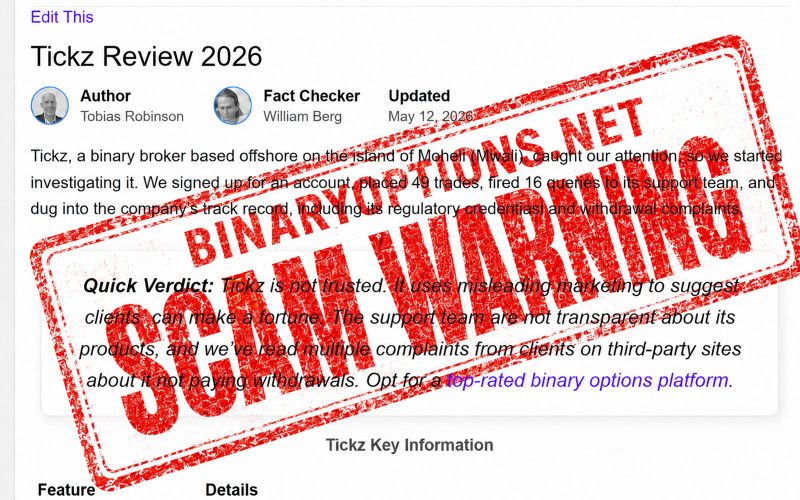
BinaryOptions.net has warned traders not to use Tickz after carrying out a hands on review of the offshore trading platform. The full broker assessment is available in the site’s Tickz review (Scam Warning), while its wider binary options broker and education coverage can be found through the BinaryOptions.net main page.
The review says BinaryOptions.net opened a Tickz account, placed 49 trades, sent 16 support queries, checked the company’s regulatory position, and reviewed external user complaints before reaching its decision. Its verdict was plain: Tickz is not trusted. The reasons given include misleading marketing, poor product transparency, offshore registration with weak practical safeguards, concerning withdrawal terms, and multiple complaints from users who said withdrawals were delayed or not paid.
According to the attached review text, Tickz is operated by Trusteo Ltd and is registered with the Mwali International Services Authority in the Comoros Union under licence number T2022073. BinaryOptions.net says that registration appeared as active, but the same record also showed a licence end date of February 17, 2025. The review also argues that MISA registration does not provide the kind of retail trader protection associated with stronger financial regulators, such as segregated client money rules, compensation protection, or robust complaint routes.
That is the centre of the warning. Tickz may be a functioning platform, and BinaryOptions.net describes placing dozens of trades on it, but a functioning interface is not the same as a safe counterparty. Traders do not only need buttons, charts, and payout percentages. They need to know who holds the money, what law applies, which regulator has authority, and what happens if the platform refuses a withdrawal.
The issues behind the warning
The first concern raised by BinaryOptions.net is marketing language. The review says Tickz used statements such as “get ready to make a fortune with your next trading opportunity” and “Trading can be surprisingly simple.” That type of wording is dangerous in binary options because it makes a difficult, high risk activity sound casual. The trade ticket may be simple. Profitability is not.
Binary options usually involve choosing whether an asset will move up or down over a fixed period. If the prediction is correct, the trader receives a stated payout. If it is wrong, the trader loses the stake. The structure is easy to explain, which is why it appeals to beginners. It is also why misleading marketing can do real damage. A product can be simple to click and still be hard to trade well.
The second concern is regulatory quality. BinaryOptions.net says Tickz claims registration through MISA, but says this should not be mistaken for strong investor protection. The review states that MISA does not mandate segregated accounts, does not provide investor compensation if a broker fails, and does not offer strong dispute channels for clients with withdrawal issues. For retail traders, that is not fine print. That is the safety net, or the lack of one.
The third issue is product transparency. BinaryOptions.net says Tickz denied being a binary options platform despite offering products that, in the reviewer’s view, clearly behave like binary contracts. The review describes users choosing buy or sell, selecting expiries from five seconds to five hours, staking from $1, and receiving a percentage payout if correct while losing the stake if wrong. BinaryOptions.net says support staff responded with statements such as “We are not a binary platform” when challenged on this point. That kind of denial matters. If a broker is vague about the product, the client is being asked to trade through fog.
Withdrawal complaints are another major part of the warning. BinaryOptions.net says it found 14 Google Play complaints from users reporting delayed or unpaid withdrawals. It also says Tickz had a warning on Trustpilot after suspicious features were detected about the company, with new reviews blocked. The review does not claim to prove every complaint. It does say the pattern is worrying enough to form part of its verdict.
Then there are the terms and conditions. BinaryOptions.net highlighted a clause allowing Tickz to deduct up to 20% commission from withdrawals. It also pointed to a dispute cap tied to deposits only, language allowing an initial deposit to be held for 180 days over paperwork, and governing law in the Union of the Comoros. These are not small details for someone trading with real money. If a platform can charge heavily on exit, cap disputes, and place legal recovery in a remote jurisdiction, traders need to understand that before they fund the account.
The trading experience itself did not rescue the review. BinaryOptions.net said it spent more than 20 hours testing the platform over two weeks and found a basic web interface with charts, indicators, drawing tools, and one click trade placement. It also reported glitches, including a chart annotation issue that paused the interface and required a page refresh. The review further criticised gamified features, including moving deposit icons and social trading style prompts, which may encourage inexperienced users to trade more often.
Why the Tickz case should concern traders
The Tickz case matters because many traders still judge platforms by surface features. A low minimum deposit, quick registration, simple trade ticket, and modern interface can make a broker feel accessible. None of those features answer the important question: what protection does the client actually have?
BinaryOptions.net says Tickz accepts a $10 minimum deposit and offers trades from $1, with payment methods including cards, Apple Pay, Google Pay, Binance Pay, KuCoin, ByBit Pay, Volet, USDT, Ton, Bitcoin, and Ethereum. That mix lowers the barrier to entry. A trader can move from curiosity to funded account very quickly. Speed is useful when the counterparty is strong. It is dangerous when the counterparty is poorly checked.
Binary options also raise the stakes because the product encourages short decision cycles. Tickz reportedly offers timeframes from five seconds to five hours. The shorter the expiry, the less time a trader has to think, document, question, or step away. A platform that combines rapid trading with weak transparency deserves extra scrutiny. The loss does not have to come only from market direction. It can come from terms, withdrawals, and account control.
This is why the warning should be read as more than a single broker review. It shows the kind of due diligence traders should apply to any platform selling high risk products, especially from offshore jurisdictions. A broker can look usable and still be unsuitable. That is not a contradiction. It is the whole problem.
Staying safe before opening a trading account
Before depositing with any broker, traders should identify the legal company behind the brand. The website name is not enough. The trading app name is not enough. The company name, registration number, office address, regulator, licence status, and complaint process should be clear. If a broker cannot explain these details plainly, there is no good reason to send money first and ask later.
Regulator checks should be done through official databases, not links supplied by the broker. For UK related firms, traders can check the FCA register and warning list. For US markets, relevant checks may include the CFTC, SEC, FINRA BrokerCheck, and NFA BASIC, depending on the product being offered. The point is not to collect logos. The point is to confirm whether the exact company and exact website are authorised for the exact activity being sold.
Matching details is vital. Clone firms and weak operators often rely on partial verification. A trader may find a similar company name and assume everything is fine. It is not. The domain, email address, phone number, payment beneficiary, and legal name should all line up with official records. If the broker name says one thing but the payment recipient says another, that is not a harmless admin quirk. It is a reason to stop.
Withdrawal terms should be read before funding. Large withdrawal commissions, broad discretion to freeze accounts, bonus conditions, long holding periods, and dispute caps all matter. These terms are dull until the trader needs their money back. In the Tickz review, the highlighted 20% withdrawal commission is the sort of clause that should make any trader slow down.
A small test deposit can reduce exposure, but it cannot replace verification. Some unsafe platforms allow small withdrawals early to build trust. Still, testing the withdrawal process before increasing account size is sensible. Traders should also keep records from day one: account documents, payment confirmations, chat logs, emails, screenshots, and copies of terms. Evidence collected early is cleaner than evidence reconstructed later in a mild panic.
Platform behaviour also matters. Be cautious where the interface pushes constant activity, deposit prompts, trading battles, social trading competitions, or emotional rewards. Those features may be presented as engagement tools, but for inexperienced traders they can weaken discipline. A trading plan should be set before logging in, not improvised because a shiny trophy icon keeps winking from the screen.
If withdrawals stall, act quickly
If a platform delays or refuses withdrawals, stop sending money. Do not pay extra taxes, release fees, compliance charges, or account unlocking deposits unless the demand is independently verified through official sources. In many scams, the second payment is where the real damage compounds.
Save all evidence immediately. Keep screenshots, account statements, trade records, withdrawal requests, chats, emails, payment receipts, wallet addresses, and terms. Contact the bank, card provider, payment app, exchange, or wallet service used to fund the account. Then report the matter to the relevant regulator or consumer protection body in your jurisdiction.
Be especially careful with recovery firms that appear after the loss. Some will promise to retrieve funds for an upfront fee. Often, that is just the second scam wearing a cleaner shirt.
This article was last updated on: May 20, 2026