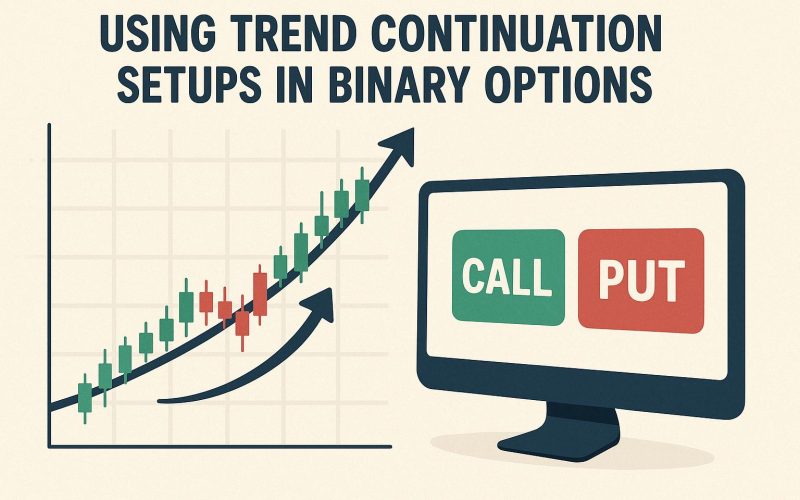
Understanding Trend Continuation Setups in Binary Options
Trend continuation setups hold a significant place in the binary options trading realm, emphasizing the sustenance of a prevailing trend as opposed to its reversal. By harnessing the momentum that a current trend provides, traders can potentially amplify their chances of conducting successful trades with relatively lower risk. This article will delve deeper into understanding the methodology of trend continuation setups, defining their context, elaborating on essential indicators, examining their practical application, and evaluating associated risks.
Defining Trend Continuation
Trend continuation in the context of binary options trading refers to the strategy of detecting an ongoing trend in the market and aligning trades to move in this direction. The objective is to capitalize on the current market movements, hence mitigating risks and heightening the likelihood of achieving favorable results. Executing such a strategy necessitates a thorough grasp of market dynamics and the adeptness to accurately decipher an array of financial indicators.
Key Indicators for Trend Continuation
Employing the appropriate indicators is pivotal for pinpointing potential trend continuations. Among the myriad of indicators at a trader’s disposal, three stand out as fundamental:
1. Moving Averages: As lagging indicators, moving averages play a critical role in streamlining price data, thereby assisting traders in discerning ongoing trends across varying timeframes. The simple moving average (SMA), calculated as an average of a specific set of prices, and the exponential moving average (EMA), which places more weight on recent prices, are two of the most prevalent types employed by traders.
2. Trendlines: These are visual tools used on price charts to manifest the trend’s direction. By linking consecutive high points or low points, traders can ascertain critical support and resistance levels, which serve as decision-making markers for entry and exit points.
3. Volume Indicators: Analyzing the trading volume is instrumental in gauging the robustness or weakening of a trend. Higher volumes frequently correlate with stronger trends, suggesting sustained market interest, while dwindling volumes could signify a potential trend reversal.
Using Trend Continuation in Practice
Implementing a trend continuation strategy necessitates a sequential and analytical approach. Initially, traders should engage in price chart analysis to detect existing market trends. Tools such as candlestick patterns, which offer visual depictions of price movements, and sophisticated technical analysis software are indispensable in this analytical phase.
Upon the successful identification of a trend, the next step is to establish the appropriate expiration time for the binary option at hand. This timing decision is crucial and should ideally reflect the anticipated longevity of the trend and the prevailing level of market volatility. For instance, in highly volatile markets, shorter expiration times are recommended, whereas more stable trends may benefit from extended durations to realize full potential.
Risks and Considerations
Despite the perceived advantages, adopting a trend continuation approach comes with inherent risks. Market trends are susceptible to sudden and unforeseen shifts, which can emanate from economic news or changes in global financial landscapes, thereby generating unfavorable outcomes for traders. As such, it becomes vital for traders to integrate risk management strategies into their trading plans. This could entail setting predetermined loss limits to contain downside risks and ensuring portfolio diversification to buffer against individual trade setbacks.
In summary, capitalizing on trend continuation setups within the binary options arena calls for a strategic and informed approach. A deep understanding of market indicators is essential, as is proficiency in the mechanics of trend behavior enveloped with analytical rigor. Traders equipped with these tools and insights are likely to enhance their chances for profitability. Concurrently, remaining abreast with market developments and persistently refining strategies based on real-time data and previous trade results are indispensable practices for sustained success.
This article was last updated on: July 25, 2026