Understanding Binary Options Trading
Binary options trading is a fundamental yet highly structured form of financial trading. It operates on a simple principle: If the specified condition of the trade is met, a trader receives a fixed payout, and if it isn’t, the trader suffers a predetermined loss. This framework of trading is particularly attractive for its clarity—offering a transparent way of trading where the possibilities boil down to a definitive “yes” or “no” outcome. This binary nature renders the financial markets more accessible to new traders, yet entails significant risk that should be thoroughly understood.
The Dynamics of Binary Options
At the core of binary options trading is the understanding of market directions and price levels. Traders need to accurately predict whether the price of an asset, such as a stock or commodity, will rise above or fall below a specific level within a set time frame. The defined nature of binary options—where results are fixed—encourages strategic planning and analysis to make informed decisions.
The Impact of Market Conditions on Trading
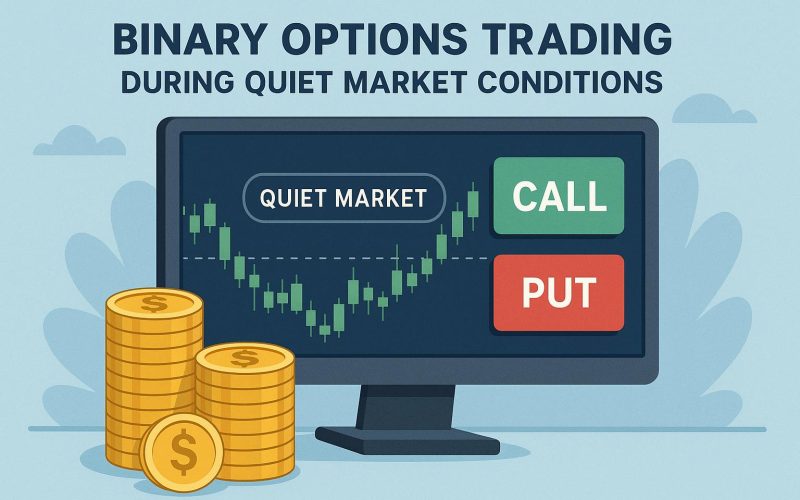
The landscape of binary options trading is largely influenced by the prevailing market conditions. These conditions affect asset prices, volatility, and traders’ decision-making processes. In particular, quiet market conditions—defined by their low volatility and limited price fluctuations—present a distinct set of circumstances. Understanding these variations is crucial for anyone engaging in trading binary options.
Advantages of Trading in Quiet Markets
Engaging in binary options trading within quiet markets can provide distinct advantages. The minimal price fluctuations and low volatility create an environment where price movements are more predictable. With reduced market noise, traders can engage in detailed technical analysis. The patterns observed in price charts tend to be more coherent, offering clearer signals for making trading decisions. As a result, traders may face fewer unexpected price spikes, allowing them to anticipate market behavior more accurately.
Risk Management in Quiet Markets
A significant aspect of successful trading lies in effective risk management. In quiet markets, where volatility is subdued, the potential for both gains and losses moderates. This environment allows for a more calculated approach toward risk management, enabling traders to safeguard their investments by weighing the risk-reward ratio diligently. Adapting strategies to align with less volatile conditions and maintaining a vigilant stance becomes imperative. By carefully calculating how much to risk per trade and setting firm limits, traders can safeguard their capital even in less turbulent markets.
Strategies to Consider
In quiet market scenarios, applying strategic approaches becomes vital. Here are some strategies:
Range Trading: Quiet markets often display limited price movement, making range trading a viable approach. This strategy involves recognizing and capitalizing on the price of an asset that fluctuates within a fixed range.
Boundary Options: These options are particularly suitable for stable markets. They are profitable when the price of an asset remains between two specified limits. This strategy capitalizes on the lack of significant price movement and the asset’s stability within a defined range.
Challenges of Trading in Quiet Markets
Despite their benefits, quiet markets present several challenges. The lack of significant volatility often results in reduced profit margins since there is less opportunity for considerable asset price shifts. Traders must improve their precision in predicting price movements to succeed in such an environment where errors bear greater consequences. Additionally, the absence of substantial market momentum complicates the identification of clear trading opportunities, requiring traders to be more judicious and attentive in their analysis.
Adapting to Potential Market Changes
Quiet market conditions can be transient. Economic news releases, financial reports, or geopolitical events can disrupt the calm, leading to sudden market volatility. Traders must remain alert to potential announcements that could influence their trades unexpectedly during these times. Keeping abreast of economic calendars and news can provide insights into impending market fluctuations.
Continual Learning and Adaptation
Successful binary options trading necessitates ongoing learning and adjustment. Regularly refining analytical skills and updating trading strategies in response to market trends is essential. Traders often benefit from studying historical market patterns and incorporating new methodologies. Joining trading communities and forums or engaging in discussions with other traders facilitates knowledge exchange and stays attuned to industry changes.
Navigating Binary Options Platforms
Selecting the right binary options platform plays a significant role in a trader’s success. The platform should offer a user-friendly interface, access to comprehensive market data, and a range of resources. Conducting thorough research on the platform’s reputation, features, and regulatory compliance equips traders with the information needed to make informed decisions.
Conclusion
Quiet markets, while presenting unique challenges, also offer distinct opportunities for binary options trading. Traders with a keen eye for recognizing market conditions and adapting their strategies accordingly can thrive even during periods of low volatility. Understanding the intricacies of such markets allows traders to navigate the binary options landscape more effectively. For those seeking to explore this avenue further, accessing reputable financial news websites and engaging in trading forums offers valuable insights into the ever-evolving world of binary options.
With the potential for profitability clearly in view, traders must approach binary options with an understanding of both risks and opportunities—maintaining a balanced perspective to maximize their chances of success.
This article was last updated on: May 8, 2026